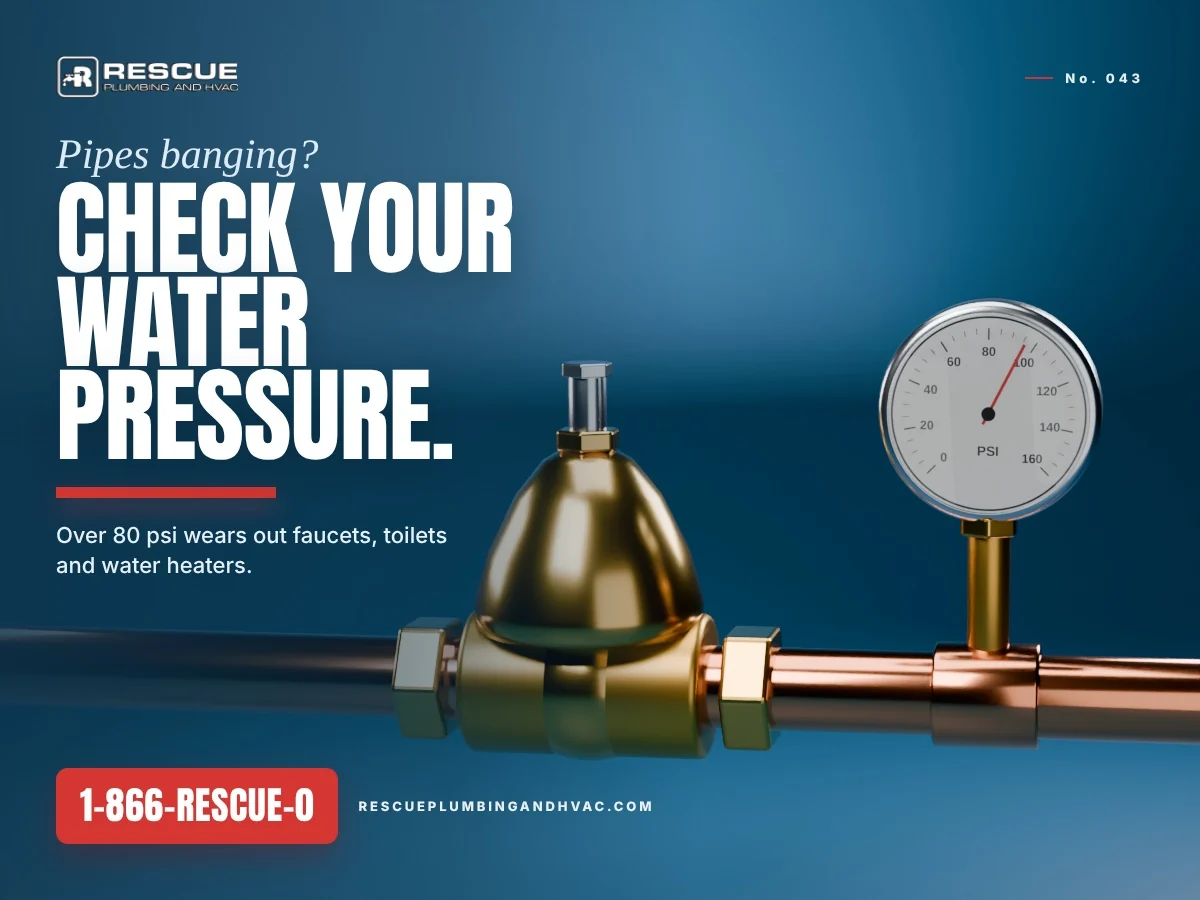
Most people never think about their home's water pressure until something goes wrong: pipes that bang when a faucet shuts off, a toilet that keeps running, or a water heater relief valve that drips. In many North Jersey homes, pressure that's too high is the hidden cause.
What's normal
Most homes are comfortable somewhere around 40 to 60 psi. Plumbing codes generally call for a pressure-reducing valve when the pressure coming into the house is over 80 psi, because pressure that high is hard on everything connected to it.
Signs your pressure may be too high
- Banging or hammering pipes when a faucet, washer or dishwasher shuts off.
- Dripping faucets and running toilets that come back soon after a repair.
- A water heater relief valve that drips or a discharge pipe that's often wet.
- Short-lived washer and dishwasher hoses, or fixtures that wear out early.
- Spray that's too strong at the sink or shower.
How to check it yourself
A simple pressure gauge from a hardware store screws onto an outdoor faucet or the laundry faucet. Turn off any water running in the house, open that faucet fully and read the gauge. Check it more than once, including early in the morning or late at night, when pressure from the street is often highest.
What a pressure-reducing valve does
A pressure-reducing valve (PRV) is a bell-shaped brass valve, usually near the main water shut-off where the line comes into the house. It lowers street pressure to a safer level for the whole home. PRVs wear out over time, so a house that used to be fine can creep back up to high pressure. Sometimes it just needs adjusting; sometimes the valve needs to be replaced.
How we help
Our technicians can test your pressure, check or adjust the valve, and tell you honestly whether it needs replacing. We start with a $79 diagnostic, credited toward the repair if you go ahead, give you a written price before any work starts, and back every job with our 1-year parts and labor warranty. Same-day service, 24/7.
Learn where your main water shut-off is, read about how long a water heater lasts, or see our plumbing services.
- What is normal water pressure for a house?
- Most homes are comfortable around 40 to 60 psi. Plumbing codes generally call for a pressure-reducing valve when incoming pressure is over 80 psi.
- How do I test my water pressure?
- Screw a pressure gauge onto an outdoor or laundry faucet, make sure no other water is running, open the faucet fully and read the gauge. Check at different times of day.
- What does a pressure-reducing valve do?
- It lowers the pressure coming from the street to a safer level for your whole home. It's usually near the main water shut-off.
- Can high water pressure damage a water heater?
- It can add stress to the tank and can make the relief valve drip. If your relief valve is dripping, have the pressure checked.