Newark winters don't negotiate.Neither should your quote.
From Forest Hill colonials to two- and three-families across the North Ward, a lot of Newark leans on forced-air furnaces that are well past their prime. When yours is finished you get fixed written options, sized from the house and permitted properly — not a number over the phone that doubles on install day.
- Sizing heat-load calculated
- Quote fixed & written
- Financing 0% for 12 months
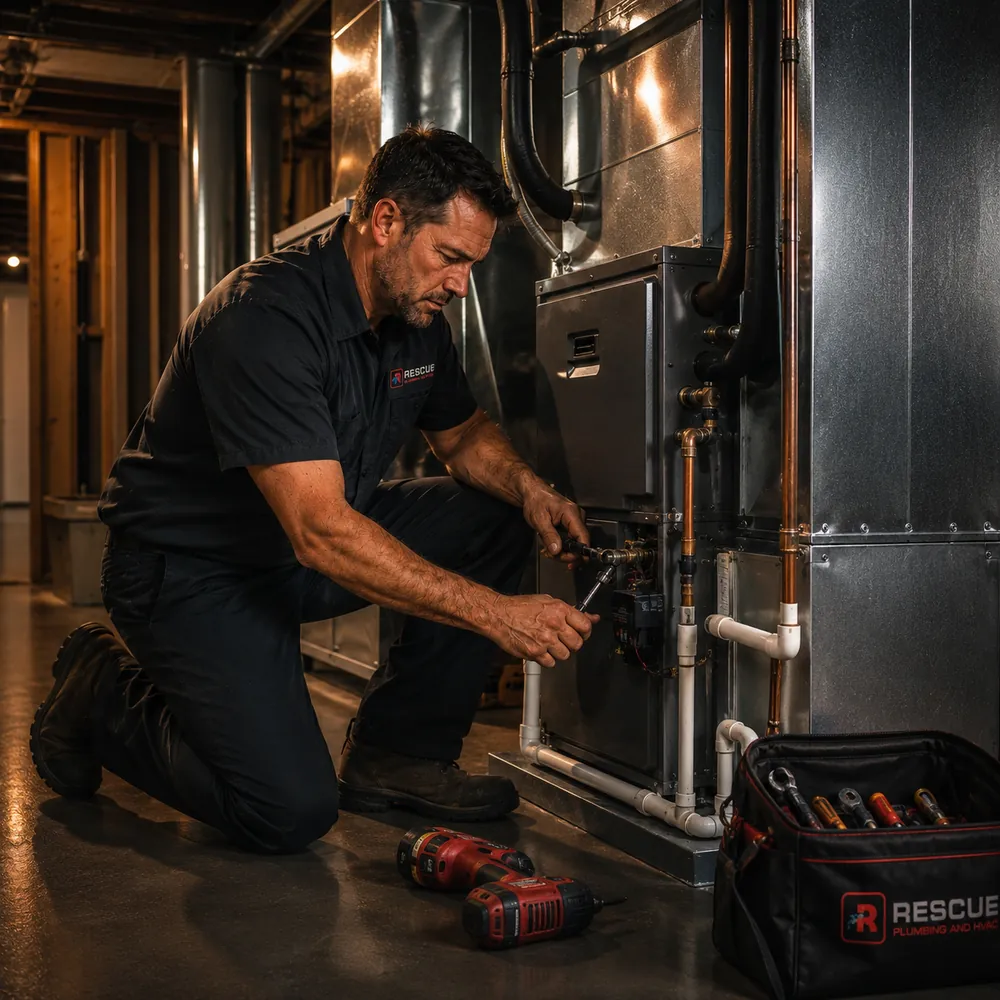
existing ductwork
What we see here
Newark's housing decides most of the job before we arrive
Dense, older, and often multi-family. Each of those changes what a correct replacement looks like, and all three get skipped by a phone quote.
- Two- and three-families
- Separate systems, shared everything elseEach unit usually has its own furnace but they share a chimney, a gas meter run and often a basement. Replacing one appliance on a shared flue changes how that flue behaves for the others, which is a real safety consideration rather than a formality.
- Forest Hill and older streets
- Chimney-vented, converted long agoMany were converted from other fuels decades back and still vent through masonry. A condensing furnace vents in PVC through a side wall instead, which is usually better — where the route exists and looks acceptable from the street.
- Tight basements
- Access is real labourGetting an old unit out and a new one in through a narrow stair or a bulkhead takes time, and we price it visibly rather than discovering it on the day and asking for more money.
- Combustion air
- The part nobody mentionsA basement that's been sealed up or finished can starve a furnace of the air it needs to burn safely. It gets checked as part of the quote, because it's both an efficiency issue and a carbon monoxide one.
If you're a landlord replacing units across a building, tell us — there's usually a sensible sequence and a better price for doing several at once than for doing them one emergency at a time over three winters.
No starting-at games
What's in the quote
One fixed price, itemised, before anything begins. The number you sign is the number you pay.
- Sizing
- Heat load, not the old labelCalculated from the house — volume, insulation, windows, infiltration, ductwork. Matching the nameplate on a forty-year-old furnace just repeats whatever was wrong then.
- Venting
- Designed and checkedCondensing units vent in PVC and need a condensate route. Non-condensing units need a correctly sized chimney liner, and on a shared flue that calculation matters for the neighbours too.
- Gas and electrical
- To current codeGas line sizing checked for the new input, sediment trap, shut-off, plus the electrical disconnect and circuit. These are the small things inspectors actually fail people on.
- Permit and warranty
- Filed and registeredCity permit filed and inspection coordinated by us, and the manufacturer warranty registered inside the window that actually starts the parts coverage.
Installed pricing runs $4,995–$7,495 for an 80% AFUE furnace and $6,995–$10,995 for a 95%+ AFUE condensing unit. Chimney liners, venting routes, gas line upsizing and difficult access are itemised separately and visibly rather than buried in a lump sum. Financing is 0% APR for 12 months on jobs over $1,500.
How the job goes
Four steps, no mystery
We look at what you have
Including whether it's genuinely finished. A cracked heat exchanger is a replacement; an igniter is a $285 repair, and you'll be told which one you have.
Heat load, then a fixed quote
Measured from the house. Venting route decided, gas and electrical checked, everything itemised in writing before you commit.
Installed, usually in a day
Most replacements on existing ductwork are a single day. Old equipment leaves with us and the basement is left cleaner than we found it.
Permit, inspection, warranty
Filed same day, inspection coordinated, warranty registered. You get the paperwork, not a promise about it.
Getting to you
Essex County
Everything runs out of 2 John St in Haledon — dispatch, parts and the fleet bay.
Replacement is scheduled work, so the survey date matters more than the drive time. No heat in freezing weather is treated as an emergency regardless, with our published 90-minute response or $50 off the job. Permitted work is filed with the City of Newark and the inspection is coordinated by us.
Furnace replacement in Newark: the questions we get
How do I know it genuinely needs replacing?
A cracked heat exchanger is a replacement, full stop — that's a combustion safety issue and no honest company repairs around it. Otherwise: past about twenty years, repairs adding up year on year, or a unit that was oversized from the start and has never heated evenly. A failed igniter or flame sensor on a sound furnace is a repair, and we'll tell you so.
What does it cost?
$4,995–$7,495 for an 80% AFUE unit and $6,995–$10,995 for a 95%+ AFUE condensing unit. Chimney liners, venting and gas line work are itemised separately when they apply. The quote is fixed before anything is ordered — no starting-at number that grows once the old unit is out.
I own a two-family. Can you do both units?
Yes, and doing them together is usually both cheaper and safer than doing them a winter apart. Replacing one appliance on a shared flue changes how that flue works for the other, so where both are near the end it's worth planning them as one job rather than two emergencies.
Do you file the permit?
Yes, with the City of Newark, and it's part of the job rather than a surprise line item. Furnace replacement is permitted work in New Jersey and an uninspected install is a problem that surfaces later — usually at the worst possible moment, when you're selling or refinancing.
80% or 95%? Which is right for my house?
It depends on how long you're staying and whether a side-wall vent route exists. A 95% unit costs more up front and saves gas every winter, which usually wins if you're there another decade. If a condensing vent route would mean tearing through a lot of the building, an 80% unit with a correctly sized liner is a perfectly sound choice.
How long is the house without heat?
Most replacements on existing ductwork are a single day. If venting has to be rerouted or a liner installed, plan on a day and a half to two. In cold weather we schedule so you're not left overnight without heat, and we tell you which case you're in at quote stage.
Nearby & related
More from Rescue
Want a second opinion first?
We'll look at it and tell you honestly whether it's finished. No charge for the answer.