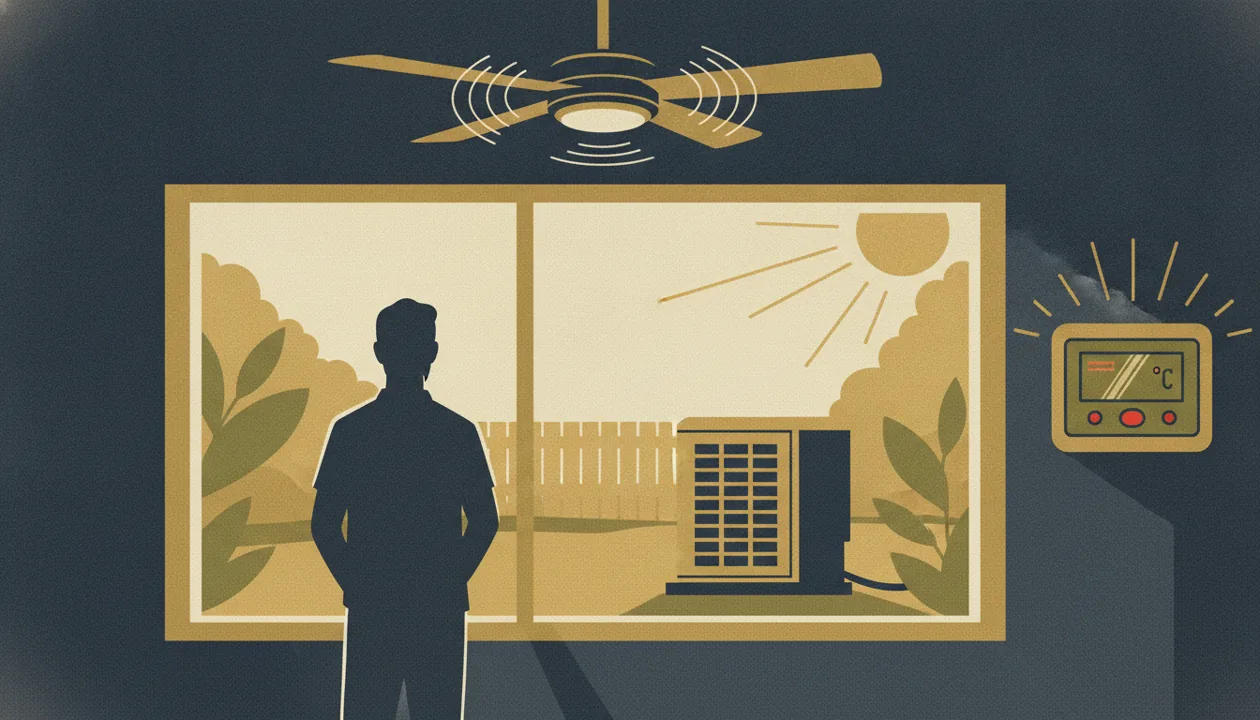
Your AC is humming, the fan is moving, but the air coming out is barely cool — or worse, room temperature. Before you spend $79 on a service call, walk through this list. Half the time it's something you can fix in 10 minutes.
Before you start: safety first
Two rules. One: turn the system OFF at the thermostat before doing anything outside the unit. Two: do not open any panel that requires tools — there are 240V circuits inside that will hurt you.
The 6-step diagnostic
1. Check the filter
This is the #1 cause of weak cooling, easily 60% of our "not cooling" calls. A filter that's gray or visibly clogged restricts airflow so badly the evaporator coil freezes solid. Symptoms: weak airflow, ice on the indoor unit's copper lines.
Fix: Replace the filter. If the coil is already iced, turn the system OFF, leave the fan ON for 4 hours to thaw, then restart with a clean filter.
2. Check the thermostat
Sounds dumb, but: is it set to "Cool" and not "Fan only"? Is the setpoint actually below room temperature? Is the battery dead (if it's battery-powered)?
Also: smart thermostats sometimes lose their schedule after a Wi-Fi outage. They'll show "Cool 72°" but actually be in "Hold" mode at 78°.
3. Check the outdoor unit
Walk outside. Is the big unit (condenser) running? You should hear a fan and a low compressor hum. Touch the side — it should be warm but not hot.
If it's not running: check the breaker panel — there's usually a dedicated double-pole breaker for the AC. Also check the disconnect box on the wall next to the unit (silver or gray box, sometimes pulled out as a service shutoff).
If only the fan is running but not the compressor: almost certainly a bad capacitor. ($249–449 for the part + service call.)
4. Check the outdoor coil
Look at the outdoor unit's fins (the radiator-like surfaces). Are they covered in cottonwood seeds, grass clippings, or pet hair? If yes, the coil can't reject heat and the system can't cool.
Fix: Turn the system OFF. Spray the outside of the fins with a garden hose from the inside out (top to bottom, gentle pressure). Don't bend the fins.
5. Check the indoor coil drain
Your indoor unit (in a closet, attic, or basement) has a drain pan and a PVC drain line. If it's clogged, the system shuts off cooling to prevent water damage but the fan keeps running.
Fix: Locate the drain line outlet (outside, usually a 3/4" PVC pipe near the foundation). Pour a cup of distilled vinegar in the access port near the unit (T-fitting with a screw cap on top of the line). If the line is fully blocked, you need a tech with a wet-vac.
6. Check vents and returns
Walk through the house. Are all the supply vents open? Are any return vents blocked by furniture, rugs, or curtains? A blocked return = restricted airflow = same symptoms as a dirty filter.
What if you've done all that and still no cool air?
Now it's almost certainly one of three things — none of them DIY:
| Issue | Symptoms | Typical fix |
|---|---|---|
| Low refrigerant (leak) | Warm air, hissing sound, ice on copper lines | Find leak + repair + recharge: $400–1,200+ |
| Failed compressor | Outdoor unit hums but no cool air, frequent breaker trips | $1,800–3,500 (often time to replace whole system) |
| Reversing valve stuck (heat pumps) | System blows hot when set to cool (or vice versa) | $450–800 |
The "do I need a new system?" question
If your tech tells you the system needs a major repair (compressor, evaporator coil, refrigerant leak in inaccessible piping), here's the math:
- System is <10 years old: Repair almost always wins. Modern systems are built for this.
- System is 10–14 years old: Compare repair cost to replacement. If repair is >40% of replacement, replace.
- System is 15+ years old: Replace, even if repair is "only" $800. You'll be back in two summers anyway, and you're paying R-22 prices for a system that's 30% less efficient than today's tech.
- System uses R-22 refrigerant: Phased out in 2020. R-22 now costs $130/lb wholesale and a typical recharge needs 4–8 lbs. Replace.
- Can I just add refrigerant myself?
- No, and it's illegal in most cases — refrigerant handling requires EPA 608 certification. Also, simply adding refrigerant doesn't fix the leak that caused the loss. Within weeks you'll be in the same spot.
- Why does my AC freeze up?
- Three causes in order of frequency: dirty filter, low refrigerant, failing blower. Always check the filter first.
- Should I cover my outdoor AC unit in winter?
- No, despite what the internet says. Modern condensers are designed for outdoor exposure year-round. Covers trap moisture and create homes for rodents that chew wiring.
- What's the lifespan of a residential AC in NJ?
- 12–18 years for a properly-maintained, properly-sized system. Northern NJ's climate is gentle on AC compared to the South — you have winter rest periods that let units recover.