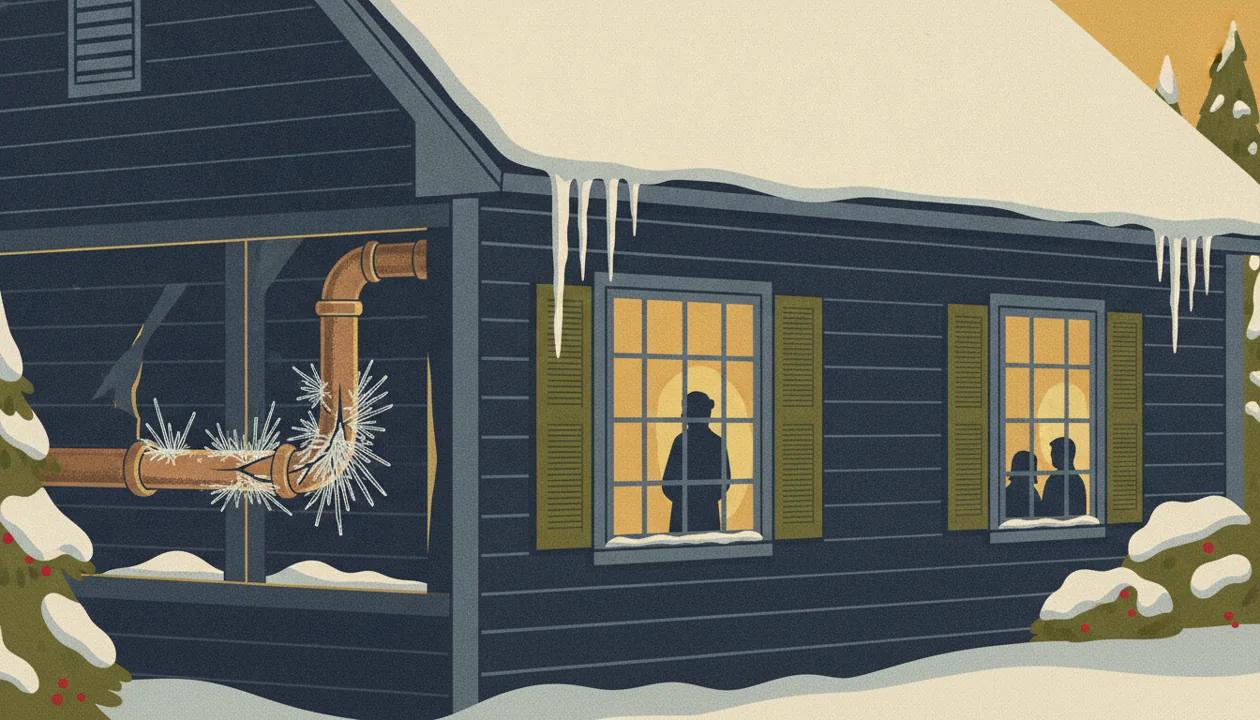
When the temperature drops below 20°F for more than a few hours, pipes in unheated walls, basements, attics, and crawlspaces start freezing. By the time you notice, it's often too late. Here's the playbook our techs use, and what to do if a pipe has already burst.
The 4 places pipes freeze in NJ homes
- Exterior wall plumbing — kitchen sinks on outside walls (super common in Newark and Hackensack pre-1960 homes).
- Garage walls — especially if there's a laundry sink or hose bib on a shared wall.
- Crawl spaces — the worst offender, because nobody checks until the floor is wet.
- Basement supply lines near rim joists — air leaks at the top of the foundation drop the temp 30°F.
The 24-hour prep before a freeze
When the National Weather Service forecasts a hard freeze, do these four things that morning — they take 20 minutes total.
- Open cabinet doors under any sinks on exterior walls. Warm room air needs to circulate around the supply lines.
- Trickle the most-vulnerable faucets — pencil-lead-thin stream. Running water doesn't freeze, and the open spigot relieves pressure even if a pipe deeper in the wall does.
- Disconnect garden hoses. A connected hose holds water in the spigot, which freezes and splits the pipe behind the wall.
- Set the thermostat to 65°F minimum — even when nobody's home. Saving $15 on heat to face a $4,000 burst-pipe repair is the worst trade in NJ home ownership.
If a pipe has already frozen (no break yet)
You'll know because a faucet won't run, or only drips. Don't panic — most frozen pipes can be thawed without bursting if you act fast:
- Find the closest section of pipe — usually you can hear or feel where the cold spot is. If it's behind drywall, look for the section nearest a cold exterior wall.
- Open the faucet connected to that line — fully open, both hot and cold.
- Apply heat with a hair dryer, heating pad, or hot towels — never an open flame, propane torch, or kerosene heater. Start at the faucet end and work back toward the freeze.
- Keep heat on until full water flow returns.
Don't apply heat to a section that's already burst. If you see ice expanding, drywall bulging, or hear water inside the wall — shut off your main valve immediately and call a plumber. Heating a burst pipe just speeds up the flood.
If a pipe has burst
You have about 90 seconds before the damage compounds. In order:
- Find your main shutoff. Most NJ homes have it where the water line enters — basement, crawlspace, or utility room. If you don't know where it is, find it now, before you need it.
- Turn it clockwise until it stops. The water in the pipes will keep running for a minute as it drains.
- Open every faucet in the house, hot and cold. This empties the lines and prevents secondary freezes.
- Call a plumber. If you're in our area, we have 24/7 dispatch. A tech can be on-site in 90 minutes or less.
- Document everything for your insurance — photos before you start cleanup, video walking through the affected rooms.
Prevention upgrades worth doing
If you've had a frozen pipe even once, fix the root cause before next winter. Cost-benefit ranking:
| Upgrade | Cost | Worth it? |
|---|---|---|
| Pipe insulation foam (DIY) | $30–60 | Yes — every time |
| Heat tape on most-exposed runs | $120–250 | Yes — for crawl spaces |
| Frost-free hose bib install | $280–420 | Yes — pays back in 1 freeze cycle |
| Reroute exterior-wall supply lines | $800–1,800 | Only after 2nd burst |
| Foam-fill exterior wall cavity | $1,200+ | Only with full insulation reno |
Pipe burst right now?
Real dispatcher answers in <20 seconds. Tech assigned before you hang up. Coverage across Passaic, Bergen, Essex, and Morris counties — 90 minutes guaranteed or $50 off.
- How cold does it have to be for pipes to freeze in NJ?
- Generally, 20°F sustained for 6+ hours is the threshold for unprotected pipes. But pipes in poorly-insulated walls can freeze at 28°F if there's wind exposure.
- Will my homeowner's insurance cover a burst pipe?
- Most NJ standard policies cover sudden burst-pipe damage but exclude damage from pipes that froze because the homeowner left the home unheated. If you're traveling, leave the heat at 60°F minimum and have someone check on the house.
- Should I leave the heat on if I'm leaving for vacation in winter?
- Yes — minimum 60°F, ideally 65°F. The savings from turning it down aren't worth the risk. Even better: have the system winterized professionally if you'll be gone for more than two weeks.