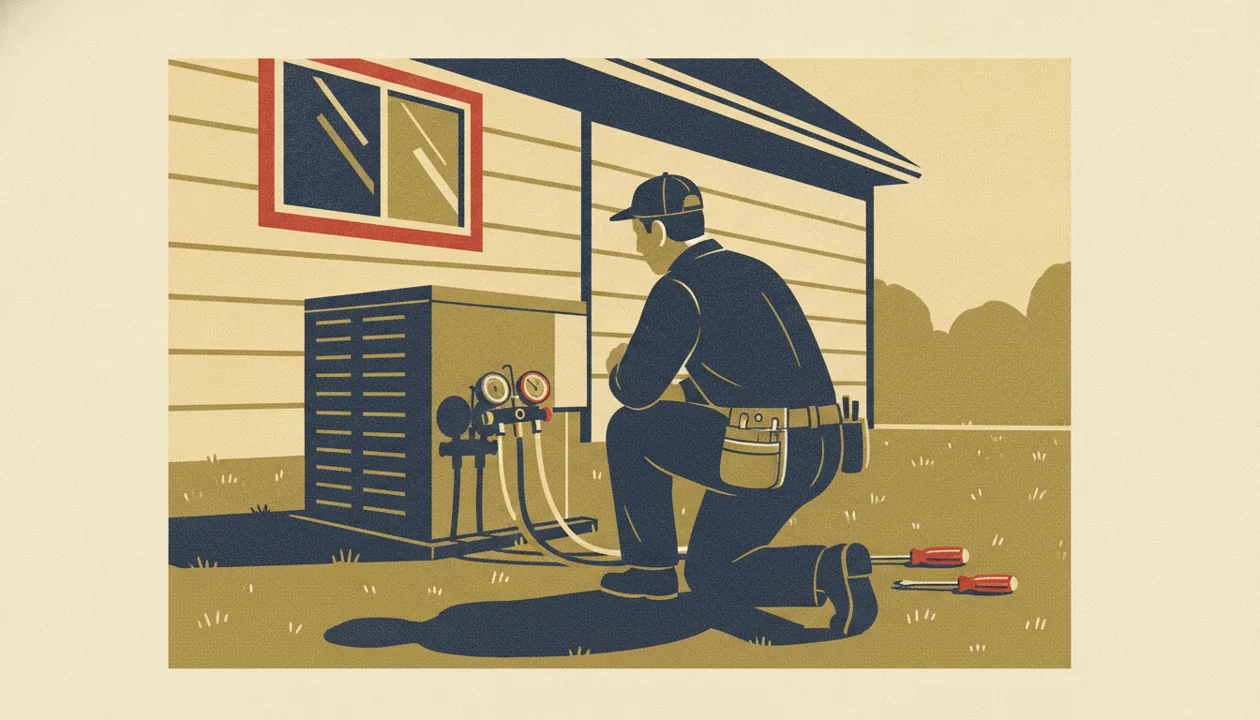
Every spring and fall we get the same question: "Do I really need to pay $189 for a tune-up if my system is working fine?" The honest answer is no, not always — but skipping it for 3+ years in a row is how mid-life systems become expensive replacements. Here's how to think about it.
What a real HVAC tune-up actually includes
A legitimate tune-up is 60–90 minutes of work, not a 20-minute filter swap. If your tech is in and out in under 45 minutes, you didn't get a tune-up — you got a checkbox visit. Here's what should happen:
- Refrigerant pressure check on AC systems — both high and low side, with the system running for at least 15 minutes to stabilize.
- Capacitor and contactor inspection — these are the #1 failure point on residential AC. A weak capacitor reads in spec at rest but fails under load.
- Coil cleaning — both indoor evaporator and outdoor condenser. A coil with 40% blockage reduces efficiency by 30%.
- Drain line flush — clogged condensate lines are the #1 callback we see in summer.
- Burner inspection on furnaces — flame color, ignition pattern, gas pressure, heat exchanger crack check.
- Blower amp draw — comparing actual to nameplate amps catches a failing motor before it dies in February.
- Thermostat calibration and electrical connections tightened.
The honest schedule
| System age | Heating tune-up | Cooling tune-up |
|---|---|---|
| 0–5 years (under warranty) | Yes, annual — required to keep most warranties valid | Yes, annual |
| 6–10 years | Annual | Annual |
| 11–15 years | Twice a year — it's earning its keep on borrowed time | Twice a year |
| 16+ years | Every visit might be the last; budget for replacement | Same |
The 6 signs you actually need service NOW (not waiting for the season)
- Higher bills with no usage change. Compare this month to the same month last year. A 25%+ jump means efficiency loss — usually refrigerant, dirty coils, or a failing motor.
- Hot and cold rooms in the same house. Could be a duct leak, a stuck damper, or a failing zone control. Don't just keep adjusting the thermostat — diagnose it.
- Short cycling — system kicks on and off every 3–5 minutes. Almost always a sensor, low refrigerant, or oversized system.
- New noises. Squealing on startup = bad blower bearing. Buzzing at the outdoor unit = capacitor about to fail. Banging from ductwork = expansion from delayed startup.
- Visible rust or rust water at the indoor unit. The drain pan is failing or already failed.
- Strange smells. Musty = mold in the ducts or coil. Burning electrical = stop using it and call. Sulfur = gas leak, evacuate and call the gas company.
What to ask your HVAC tech before they leave
If you're paying $150–250 for a tune-up, get your money's worth. Before they pack up:
- "What were the refrigerant pressures, and are they in spec?"
- "Did you measure the capacitor — what was it rated and what did it test at?"
- "What's the current state of the heat exchanger / coil?"
- "Anything you'd recommend addressing in the next 12 months?"
- "What's your honest read on how many seasons this system has left?"
A tech who can answer those crisply did the work. One who hedges or changes the subject — get a second opinion.
The maintenance plan question
Most HVAC companies offer "club" plans — pay $15–25/mo, get two tune-ups + priority dispatch + 10–15% off repairs. Are they worth it?
Yes if: your system is 6+ years old, you'd otherwise skip tune-ups, and the company actually has techs in your area (not contractors driving in from 2 hours away).
No if: your system is brand new and under warranty (you're paying twice), or the plan locks you into using only their parts.
- Should I replace my HVAC before it dies?
- Generally yes if it's 15+ years old and you'd be replacing within 2 years anyway. New 16-SEER systems can cut your cooling bills 30–40%, and an emergency replacement in July costs 20% more than a planned one in October.
- How often should I change my HVAC filter?
- Standard 1" pleated filter: every 60–90 days during heavy use seasons. 4" media filter: every 6–12 months. Got pets or allergies? Cut those intervals in half.
- Is it bad to set my thermostat to 60 when I'm gone?
- For short trips, totally fine. For multi-week vacations in winter, raise it to 65 to protect plumbing. In summer you can go up to 80 — but if you're in NJ humidity, anything above 80 risks indoor mold growth.
- Why does my AC freeze up?
- Three causes, in order: dirty filter (80% of cases), low refrigerant (15%), failing blower motor (5%). Turn it off, let it thaw 4 hours, change the filter — if it freezes again within a week, call a tech.